Commercial ice cream machines are built for very different products and production setups. The right choice depends less on finding the “best” machine and more on matching the equipment to what you plan to make and how you plan to serve it.
Choosing commercial ice cream equipment starts with three questions: what are you making, how will you serve it, and how far ahead of service will you produce it?
Those answers usually narrow the machine choice faster than a spec sheet does.
Say you are opening a shop built around a rotating gelato and sorbet menu. You want to make product in the morning, harden it, move it into a display case, and refresh flavors throughout the week. A batch freezer fits that service pattern because you are producing distinct batches ahead of service. If you also want to add variegates, nuts, chocolate or other inclusions during freezing, the choice may narrow further toward a vertical batch freezer.
Now change the concept. You are serving two flavors of soft serve, product is dispensed directly into the cup or cone, and the goal is fast service with little production labor. A batch freezer would add steps you do not need. A soft serve machine is the more natural fit.
That is the useful way to compare machine types. Their stated output figures are not directly comparable because they measure different production systems. A soft serve machine produces to serve. A batch freezer produces a batch that may then be hardened and displayed. A continuous freezer is built around an entirely different scale of production.
If you are still deciding how the equipment fits together, start with Advanced Gourmet’s gelato and ice cream equipment overview and then use the machine map below to narrow the field.
Commercial frozen dessert equipment covers more than batch freezers and soft serve machines. The right category depends on the product, production schedule, service model and space available.
| Machine | Makes | Made ahead or made to serve | Right when | AG |
|---|---|---|---|---|
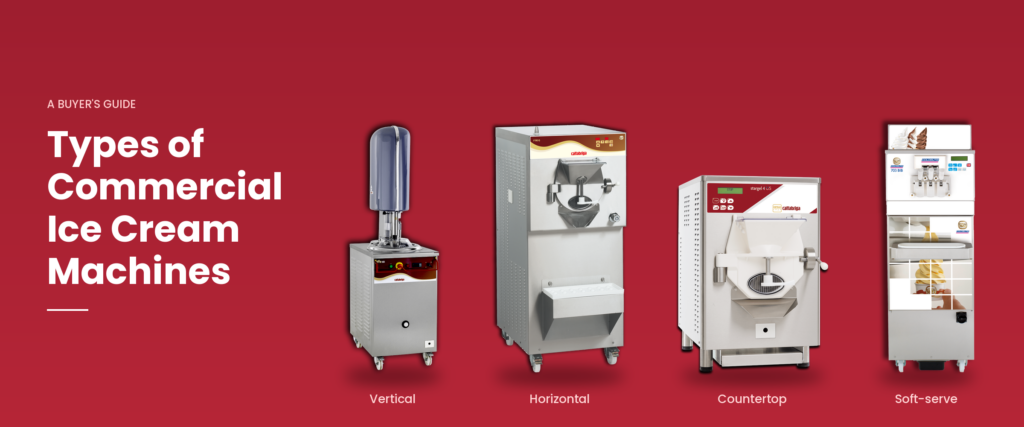
| Vertical batch freezer | Gelato, artisan ice cream, sorbet | Made ahead, hardened, displayed | Mix-ins during the run and a visible work area matter | Cattabriga Effe |
| Horizontal batch freezer | Gelato, ice cream, sorbet | Made ahead | Speed, simpler extraction and easier cleaning matter more than mid-run control | Cattabriga F45, F90 and F120 |
| Combi / multi-function | Gelato from raw mix, plus creams, custards and sauces | Made ahead | You are starting from raw ingredients, or one machine has to do several jobs | Coldelite Compacta Vario Pro, Vario Elite, Vario Classic and Ott MasterChef |
| Counter-top batch freezer | Small batches of gelato, ice cream and sorbet | Made ahead | Space is the constraint, or gelato is an addition to an existing menu | Cattabriga Stargel 4, Cattabriga K20, Coldelite Compacta 4 |
| Freeze-and-process system | Single portions, savory as well as sweet | Frozen ahead, processed to order | Flavor count matters more than volume, or the kitchen is not just desserts | Versa Pro 360 |
| Soft serve machine | Soft serve, frozen yogurt | Made to serve | Speed and low labor matter more than flavor range | Coldelite 703 BIB |
| Continuous freezer | Ice cream at volume | Made ahead, packed | Wholesale or multi-location production is the goal | Not supplied by Advanced Gourmet |
| Frozen custard machine | Frozen custard | Made to serve | The concept is specifically built around frozen custard | Not supplied by Advanced Gourmet |
The “made ahead” and “made to serve” column is especially important. A made-ahead machine belongs to a production workflow. Product leaves the machine, may move through hardening, then goes into storage or display before the customer orders it. A made-to-serve machine is part of the service line itself. Product is frozen or finished as it is dispensed.
Freeze-and-process systems sit between those patterns. With the Versa Pro 360, the product is frozen in advance and then processed by portion when ordered. That can be useful when a kitchen wants a broad flavor library without holding every flavor in a display case, or when the same equipment needs to handle savory and sweet preparations.
That distinction also explains why machine output should not be compared as though every category is measuring the same job. The useful comparison is whether the machine can support the menu and service pattern you have chosen.
The rest of this guide explains where those categories separate in practice.
A batch freezer is the core production machine for shops making gelato, artisan ice cream and sorbet in distinct flavors.
The machine freezes one batch at a time, which gives the shop control over recipe rotation and lets production move from flavor to flavor. That matters when the menu changes frequently, when seasonal flavors are part of the concept, or when individual recipes need different handling.
Batch freezers also support a production style that soft serve and continuous freezing do not. You can make one flavor, extract it, move to the next, and build the display around a deliberate assortment instead of feeding one product continuously through the machine.
The first split is vertical versus horizontal.
The Cattabriga Effe, a vertical batch freezer, gives you access to the product while it is freezing. That makes it practical to add ingredients during the run and gives the machine a visible, hands-on role in the shop. Cattabriga F-Series horizontal batch freezers close the cylinder during freezing and generally favor a more enclosed production process with straightforward extraction and cleaning.
Neither layout is automatically better. The choice depends on how much you value mid-run access, how you want production to look in the shop, and how you expect the staff to work around the machine.
Advanced Gourmet’s batch freezer lineup includes Cattabriga vertical, horizontal and counter-top machines, along with Coldelite combination systems. If you are beginning with the broader category, our batch freezer overview page is the next useful stop.
Combination and multi-function machines matter when your production starts before freezing.
The Coldelite Compacta Vario Pro and Ott MasterChef can heat and freeze in one machine. That can change the production layout substantially for a shop working from raw ingredients, preparing bases in-house, or using one machine for multiple hot and cold processes.
Whether that makes sense depends on state and local health requirements, whether you start from a pre-pasteurized mix, what else you make in the machine, and the production volume you need to support. Health requirements vary by jurisdiction, so the equipment decision should be made against the rules that apply to the shop.
Soft serve machines are the right choice when the concept is built around fast service, a focused flavor count and product dispensed directly at the point of sale. Unlike a batch freezer workflow, there is no separate production, hardening and display sequence. The machine freezes and dispenses product as it is ordered.
For shops built primarily around soft serve, machine selection should start with expected service volume, product format and the number of flavors you plan to offer. Advanced Gourmet carries the Coldelite 703 BIB, a bag-in-box soft serve system that can fit concepts where a streamlined mix and service process is important.
Continuous freezers are built for production at a scale that a typical single retail shop does not need. Instead of freezing one discrete batch and stopping, a continuous freezer keeps product moving through the freezing process for larger-volume packing and distribution. That makes the category relevant to wholesale production, central kitchens and multi-location systems where ice cream is produced at volume and shipped out. Advanced Gourmet does not currently supply continuous freezers.
Frozen custard machines are designed around frozen custard as a distinct product and service format. A frozen custard concept typically produces and serves product on a different rhythm from a gelato shop using a batch freezer and display case. If frozen custard is the product the shop is built around, a dedicated custard machine is the category to evaluate. Advanced Gourmet does not currently supply frozen custard machines.
A first-time shop owner can choose the correct batch freezer and still end up with an incomplete production system.
Three supporting equipment categories deserve to be in the plan from the beginning: mix treatment, hardening and display.
Pasteurizers and mix-treatment equipment handle the steps before freezing when your process requires them.
Cattabriga’s PSK-KEL is a bain marie pasteurizer. Cattabriga also offers the Easymix Plus 60 and Easymix Plus 120 for mix treatment. Whether you need separate pasteurization equipment depends on your process, the ingredients you begin with, and state and local health requirements.
For shops producing gelato or ice cream ahead of service, a blast freezer is typically the next step after extraction.
The batch freezer gets the product to extraction. The blast freezer is used to pull the temperature down rapidly after that point so the product can move into storage or display as part of a controlled production process.
Advanced Gourmet supplies Techfrost blast freezers and blast chillers, including the E5, E10, E15, JOF-23 and JOF-ONE.
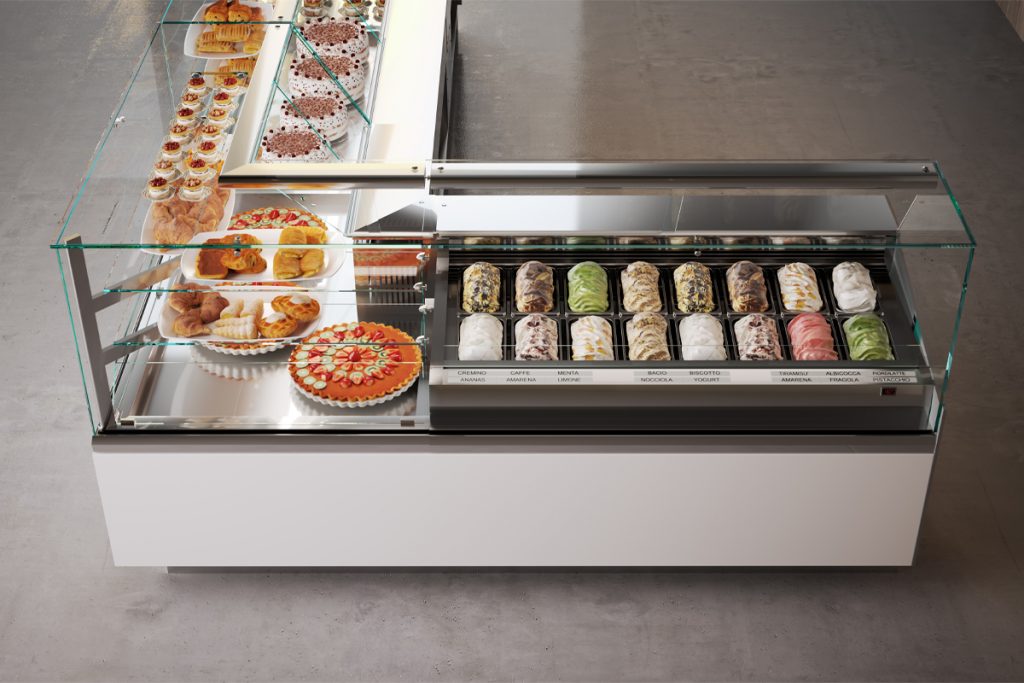
A display case is part of the frozen-dessert system, but it should not be treated as interchangeable with a storage freezer.
A gelato display case typically runs at 0 to 10°F, while a pastry case runs at 33 to 41°F. Many open-pan gelato display cases use forced-air refrigeration to maintain a consistent temperature across the display, rather than functioning like a conventional storage freezer. Those differences affect product temperature, consistency and how the case behaves during service.
Advanced Gourmet supplies Ciam gelato and ice cream display cases and base cabinetry, including the Master Collection, Verticali Collection and modular cabinetry.
Commercial ice cream equipment spans several machine categories, and the total depends on the production method, supporting equipment and shop layout. A useful budget compares complete equipment systems rather than comparing one machine in isolation.
Equipment life varies by machine type and by whether replacement parts and electronics remain available. Batch freezers commonly remain in service for 20 to 30 years, blast freezers and chillers for 15 to 20 years, and display cases for roughly 10 to 14 years.
The binding constraint is often parts and electronics availability rather than the compressor itself. Mechanical machines tend to age on the compressor clock, while electronically controlled machines increasingly age on the board-availability clock. Equipment life can vary greatly depending on how the production team uses and maintains the machine.
The best next step depends on which part of the equipment system you are trying to choose.
You can also browse Advanced Gourmet’s full gelato and ice cream equipment range to compare the equipment categories together.